
 10.5577/jomdi.e260828
Vol. 7 No. S1 (2026) Continuous Publication
View Current Issue
Search
Search Results
##search.searchResults.foundPlural##
-
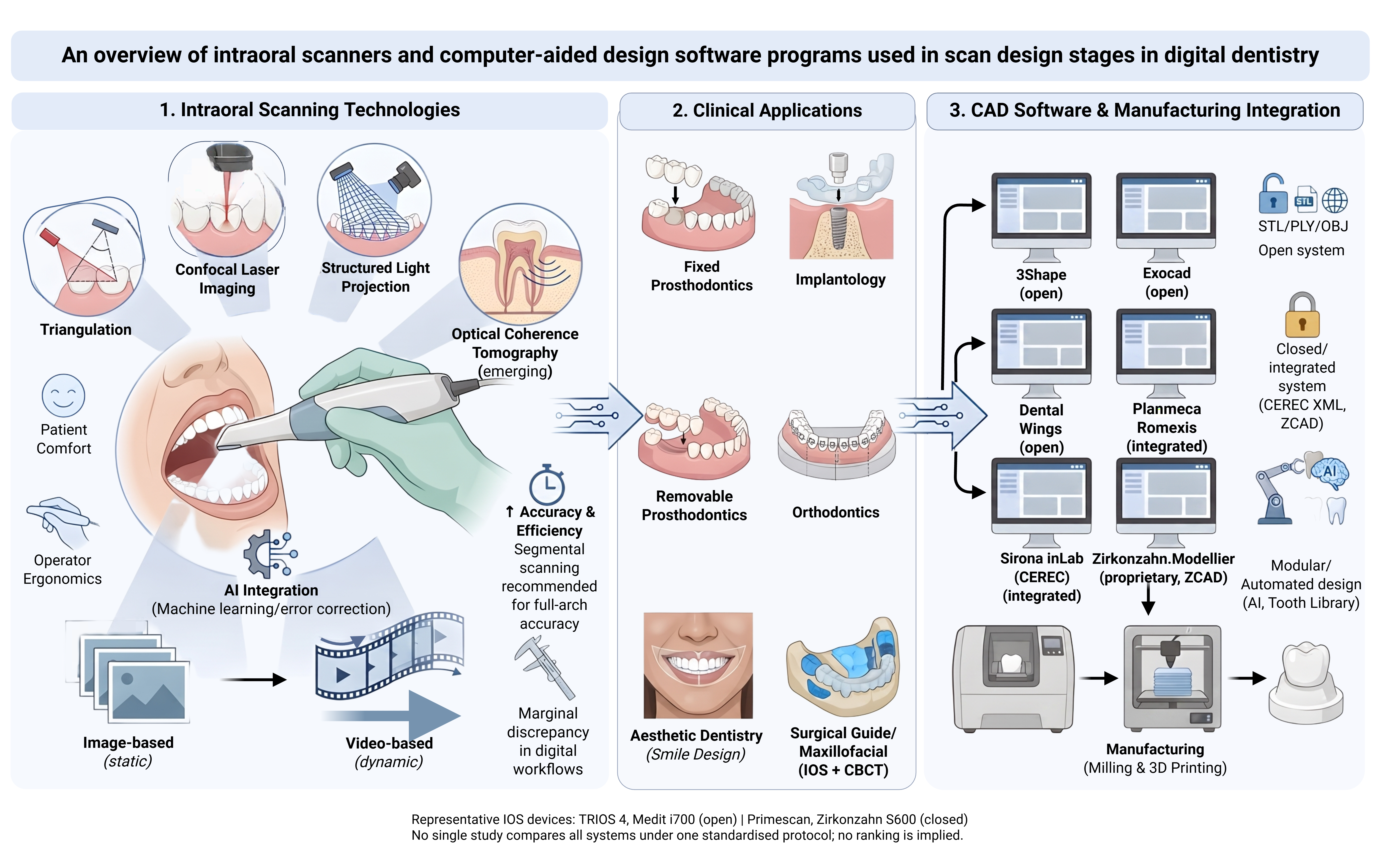
An overview of intraoral scanners and computer-aided design software programs used in scan design stages in digital dentistry
In prosthetic dental treatments, obtaining the negative of the prepared area in the most accurate way directly affects the success of the restoration to be made. Therefore, it is necessary to give importance to the impression material and the impression technique used. Impression materials have undergone changes over the years in order to record the most accurate and sensitive detail. Studies have tried to improve many physical and chemical properties of the impression material. Despite this, it should not be forgotten that there are numerous external factors such as the skill of the clinician, environmental conditions, and storage conditions for the impression to be obtained. Developments in computer-aided design and design (CAD/CAM) technology have significantly increased the use of these systems in dentistry in recent years. In dentistry, many companies in the market aim to minimize the problems that may occur in the laboratory and clinical environment by adding intraoral or extraoral scanners to CAD/CAM systems. The first step of dental CAD-CAM systems is digital scanning with an intraoral or laboratory scanner. This step is followed by the construction phase of restorations with digital design and production devices on the computer. Therefore, the success of these restorations depends largely on the accuracy and precision of the scanning devices. This review will discuss CAD/CAM systems and intraoral scanners and software programs.Digital dentistry, intraoral scanners, CAD/CAM systems, digital impression, scanning accuracy, digital workflowMuhammed Burak Süzen, Hayriye Yasemin Yay Kuşçu27.08.2026e260828 -
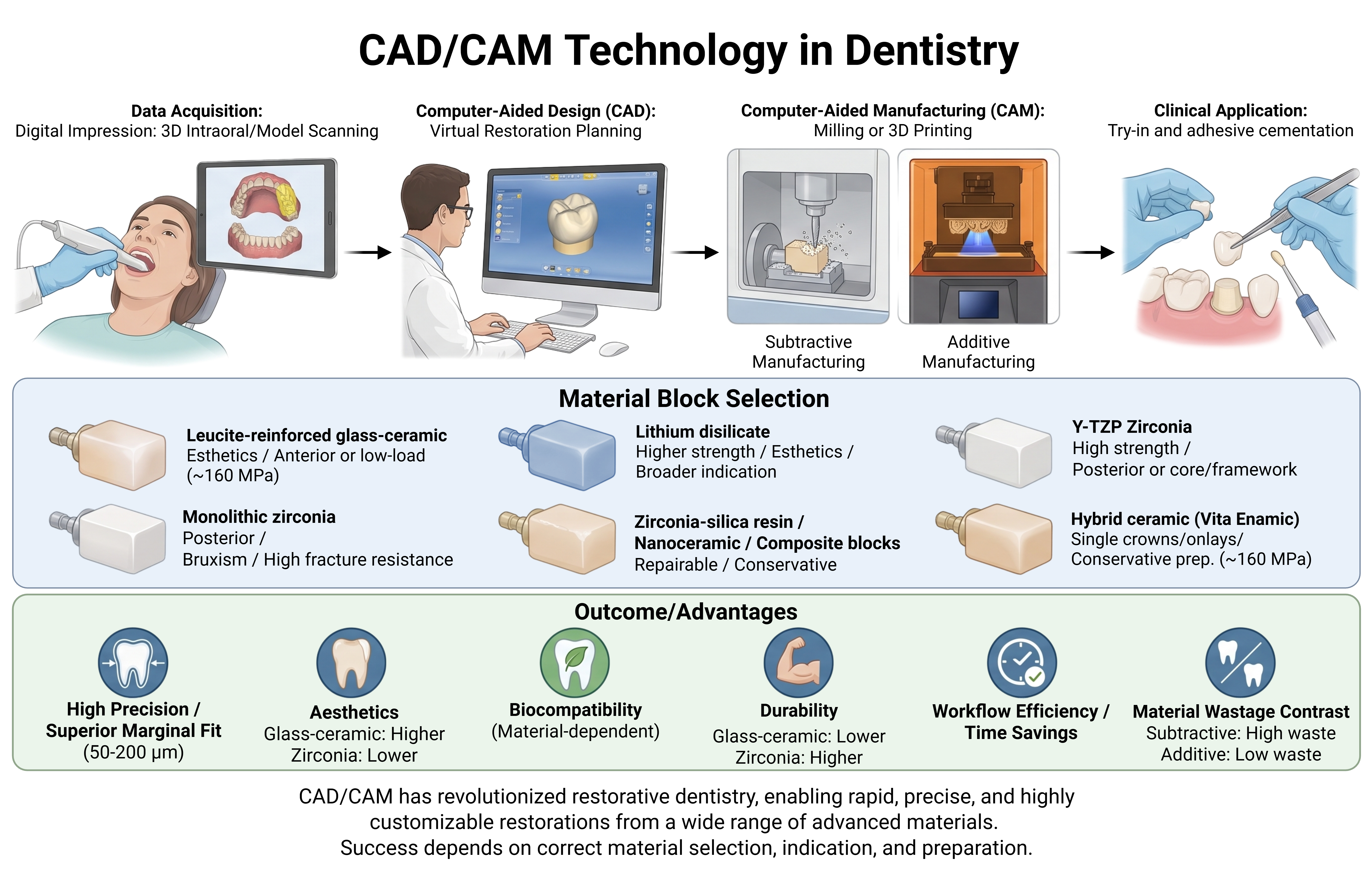
CAD/CAM technology in dentistry
The remarkable advancement of dental materials, treatment techniques, and prosthesis manufacturing processes has elevated computer-aided design and manufacturing (CAD/CAM) systems to a new level of clinical capability. Since its introduction to dentistry in the 1980s—beginning with the chairside CEREC system and the Procera framework concept—CAD/CAM has reshaped contemporary practice by enabling aesthetic, durable, and reliably reproducible restorations while transforming the way laboratories design and fabricate both framework (substructure) and monolithic restorations. Because the production stages are tightly controlled and the material blocks are industrially processed, modern CAD/CAM materials also offer improved structural properties—reduced microporosity, greater homogeneity, and lower firing shrinkage—relative to conventionally processed ones, while reducing laboratory steps, working time, and the overall error rate. This narrative review examines the principal CAD/CAM restorative materials, the digital data-processing workflow, and restoration production methods, together with their influence on marginal fit. The main material classes are described—leucite- and lithium-disilicate-reinforced glass ceramics, yttria-stabilized tetragonal zirconia polycrystals (Y-TZP) and monolithic zirconia, resin-matrix and nanoceramic blocks, composite blocks, and hybrid ceramics such as Vita Enamic—with their compositions, mechanical properties, indications, and limitations, including flexural strengths ranging from approximately 160 MPa for glass ceramics to substantially higher values for zirconia. The data-processing stage, comprising direct intraoral and indirect model scanning followed by computer-aided design of a virtual model, is reviewed, along with the two production routes: subtractive milling from prefabricated blocks and additive fabrication by selective laser sintering and 3D printing, which minimizes material waste. Marginal adaptation is discussed as a key determinant of restorative success, with reported clinically tolerable misfit values of 50 to 200 µm and CAD/CAM milling shown to provide superior marginal conformance to conventional techniques. Overall, CAD/CAM workflows offer measurable gains in material quality, accuracy, and efficiency over conventional methods, although optimal outcomes depend on correct material selection, appropriate indication, and proper tooth preparation.CAD/CAM, dental ceramics, monolithic zirconia, intraoral scanner, marginal adaptation, digital workflowZuhal Görüş, Hayriye Yasemin Yay Kuşçu, Nur Sena Alioğlu Koparal29.08.2026e260817 -
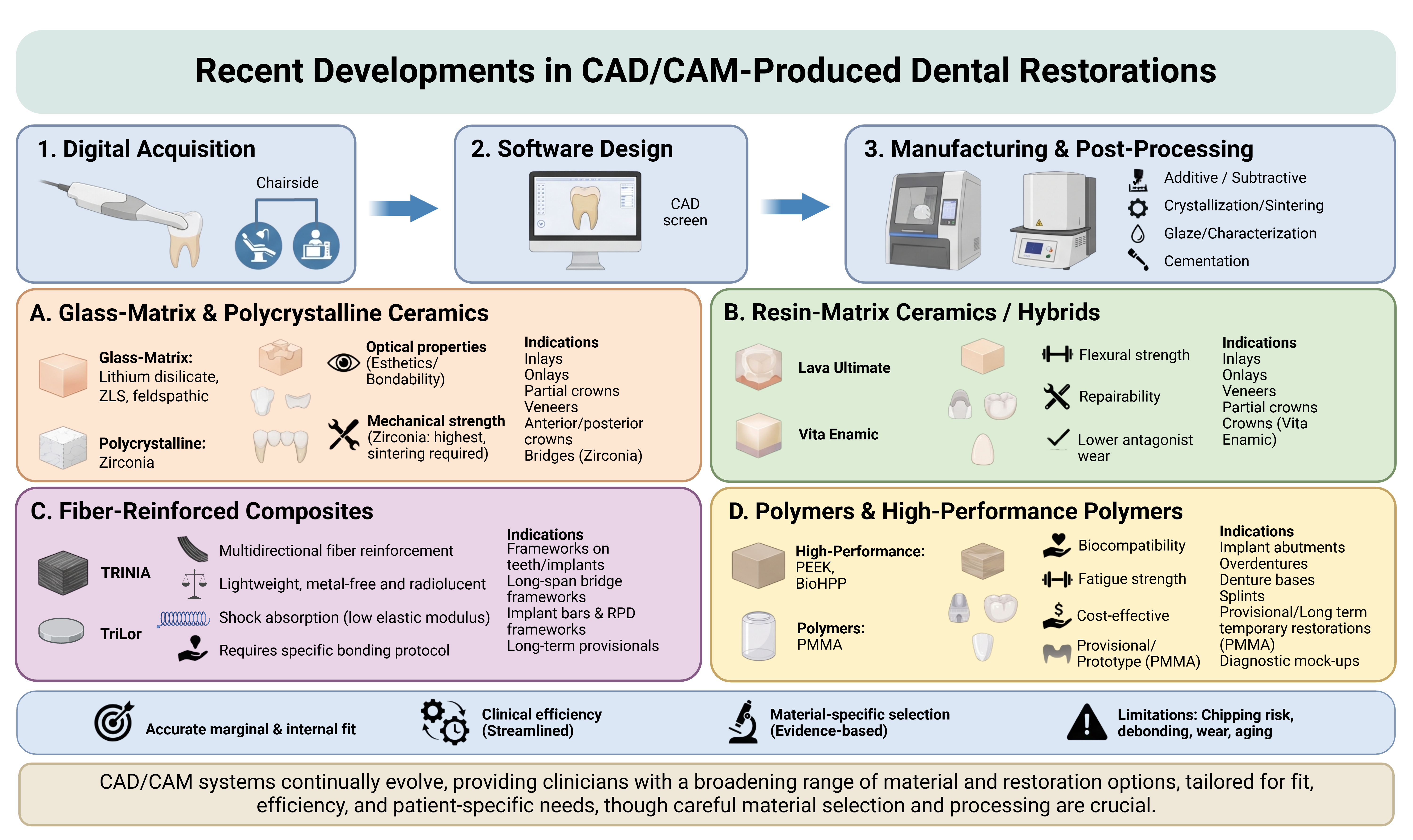
An overview of recent developments in CAD/CAM-produced restorations
The evolution of computer-aided design and manufacturing (CAD/CAM) systems has enabled the development of new materials, treatment methods, and prosthesis manufacturing processes. As innovation in material development continues, the production of new-generation materials with better functions and superior features has become possible. With CAD/CAM technology, chair-side manufacture of esthetic full ceramic restorations that are perfectly compatible with abutments has become possible. In addition, this technology has replaced resin composites applied directly intraorally with resin composite blocks produced with a milling system and applied indirectly, which are mechanically more durable. In addition, digitally produced removable prostheses have also been used widely in recent years. Thus, since the time spent by the dentist for the patient at the clinic and the number of appointments decrease, the delivery time of the prosthesis to the patient is also significantly shortened. Subjective errors due to the technician are also eliminated with these systems, and more accurate manufacture of prostheses is achieved. Because newly developed CAD/CAM materials are manufactured industrially in a standard way and the manufacturing phases are strictly controlled, they can be considered more advantageous than materials used in conventional methods in terms of structural properties. The purpose of this review is to provide physicians with a different perspective on the selection of current materials to be used in the production of CAD/CAM restorations and to assist in material selection in clinical practice.CAD/CAM, glass-matrix ceramics, zirconia, zirconia-reinforced lithium disilicate, fiber-reinforced composites, PEEKMerve Sena Ekinci, Beste Çetin29.08.2026e260820 -
Restorative options for primary teeth in pediatric dentistry
Restoration of primary teeth is a fundamental component of pediatric dental care, as primary dentition plays a critical role in mastication, speech development, esthetics, and the maintenance of arch integrity for the eruption of permanent teeth. Dental caries remains one of the most prevalent chronic diseases in children worldwide, making the selection of appropriate restorative materials essential for achieving durable and biologically acceptable outcomes. This narrative review aims to evaluate the restorative options available for primary teeth in pediatric dentistry, with emphasis on their clinical performance, advantages, and limitations. Due to the anatomical and histological differences between primary and permanent teeth—such as thinner enamel and dentin, larger pulp chambers, and shorter functional lifespan—restorative material selection in primary teeth requires specific considerations. Traditional materials, including dental amalgam, have demonstrated long-term durability and moisture tolerance; however, their use has declined due to esthetic demands and concerns regarding mercury exposure. Glass ionomer cements and their modified forms offer chemical adhesion to tooth structure, fluoride release, and cariostatic properties, making them particularly suitable for children at high caries risk, despite their relatively lower mechanical strength. Resin-based materials, such as composite resins, compomers, giomers, and ormocer-based systems, provide superior esthetics and acceptable mechanical properties, but their clinical success is highly dependent on proper isolation and technique sensitivity. Full-coverage restorations, including stainless steel crowns, veneered crowns, prefabricated zirconia crowns, and newly developed polymer-based crowns, are recommended for extensively damaged primary teeth, especially following pulp therapy. Stainless steel crowns remain the gold standard for posterior primary teeth due to their durability and cost-effectiveness, whereas zirconia and aesthetic crowns offer improved esthetic outcomes with certain limitations related to tooth preparation and retention. Recent advancements in restorative materials and digital technologies, such as CAD–CAM-fabricated crowns, have expanded treatment options in pediatric dentistry. In conclusion, no single restorative material fulfills all clinical requirements. The selection of restorative options for primary teeth should be individualized based on the child’s age, caries risk, tooth location, functional demands, esthetic expectations, and level of cooperation. Appropriate material selection contributes significantly to the long-term oral health and overall well-being of pediatric patients.Primary teeth, restorative materials, pediatric dentistry., glass ionomer cements, composite resins, zirconia crownsBüşra Karaağaç Eskibağlar, İrem İpek, Özge İlter Er, Buket Ayna30.12.2025e250070
1 - 4 of 4 items





















 Open Access articles are distributed under the terms of the