
Skip to main content Skip to main navigation menu Skip to site footer
logo
  • Login
  • Register
E-ISSN: 2822-6453
  • Home
  • Current Issue
  • Archives
  • For Authors
    • Author Guidelines
    • Online Submission
    • Reference Style
    • Call for Papers
    • Language Editing
  • For Reviewers
    • Reviewer Guidelines
    • Become a Reviewer
    • Reviewer Resources
  • Ethics and Policies
    • Artificial Intelligence (AI) Policy
    • Authorship and Contributorship
    • Conflicts of Interest
    • Copyright and Permission
    • Corrections and Retractions
    • Crossmark Policy
    • Editorial Policy
    • Human and Animal Rights
    • Informed Consent Policy
    • Journal Management
    • Open Access Statement
    • Publication Ethics Policy
    • Research Ethics Policy
  • Journal Info
    • About the Journal
    • Abstracting & Indexing
    • Editorial Board
    • Peer Review Process
    • Publication Fee
    • Society Information
    • Contact
  1. Home /
  2. Search

Search

Advanced filters
Published After
Published Before

Search Results

##search.searchResults.foundPlural##
  • Can digital impression methods eliminate the current problems of conventional impression techniques?

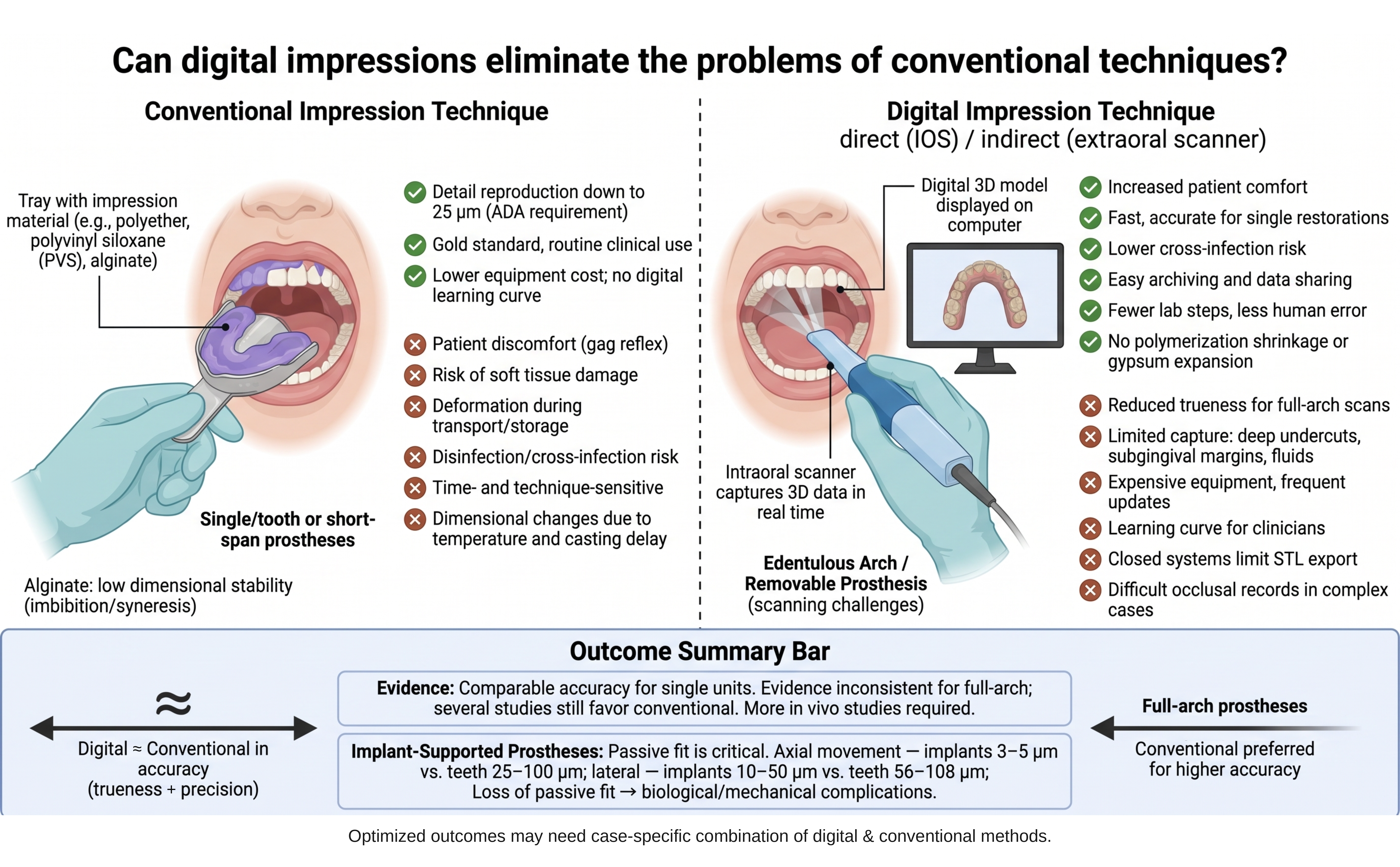
    Conventional impression materials remain a cornerstone of routine dental practice, yet they carry well-documented drawbacks, including a pronounced gag reflex, limited patient comfort, potential soft-tissue trauma, dimensional changes with temperature and elapsed time, the need for disinfection, cross-infection risk, and susceptibility to distortion during transport, storage, and laboratory handling. Digital impression systems have been introduced to overcome these limitations, and their use in dentistry—particularly in prosthodontics—continues to expand. This review compares conventional and digital impression techniques and examines whether digital workflows can resolve the shortcomings inherent to conventional methods. Conventional elastomers such as polyether and addition-type silicones offer excellent dimensional stability and detail reproduction and are currently regarded as the gold standard. Digital impressions, obtained with intraoral or extraoral scanners, provide clear advantages in patient comfort, procedure time, reduced cross-infection risk, elimination of polymerization shrinkage and gypsum expansion, and convenient digital archiving and transfer. However, their accuracy is influenced by scanning area, scanner sensitivity, operator experience, moisture, patient movement, and inter-implant distance. The reviewed literature indicates that intraoral scanners achieve clinically acceptable accuracy for single units and single-quadrant restorations, whereas evidence for full-arch and multiple implant-supported prostheses remains inconsistent, with several studies still favoring conventional impressions. Accuracy—comprising trueness and precision—is especially critical for passive fit in implant-supported restorations. Most comparative data derive from in vitro models that do not reproduce intraoral conditions such as saliva, blood, and patient movement, underscoring the need for further in vivo research. In conclusion, although the benefits of digital impressions are evident, their long-term clinical efficacy and safety require additional investigation, and technique selection should weigh accuracy, time efficiency, learning curve, and cost. A case-specific combination of digital and conventional approaches may offer added benefit.
    Digital impression, intraoral scanner, conventional impression, trueness and precision, prosthodontics
    Yakup Kantaci
    27.08.2026
    e260815
    Abstract Views: 234 Download: 81 DOI 10.5577/jomdi.e260815
  • Comparison of scanning accuracy of different digital intraoral scanners

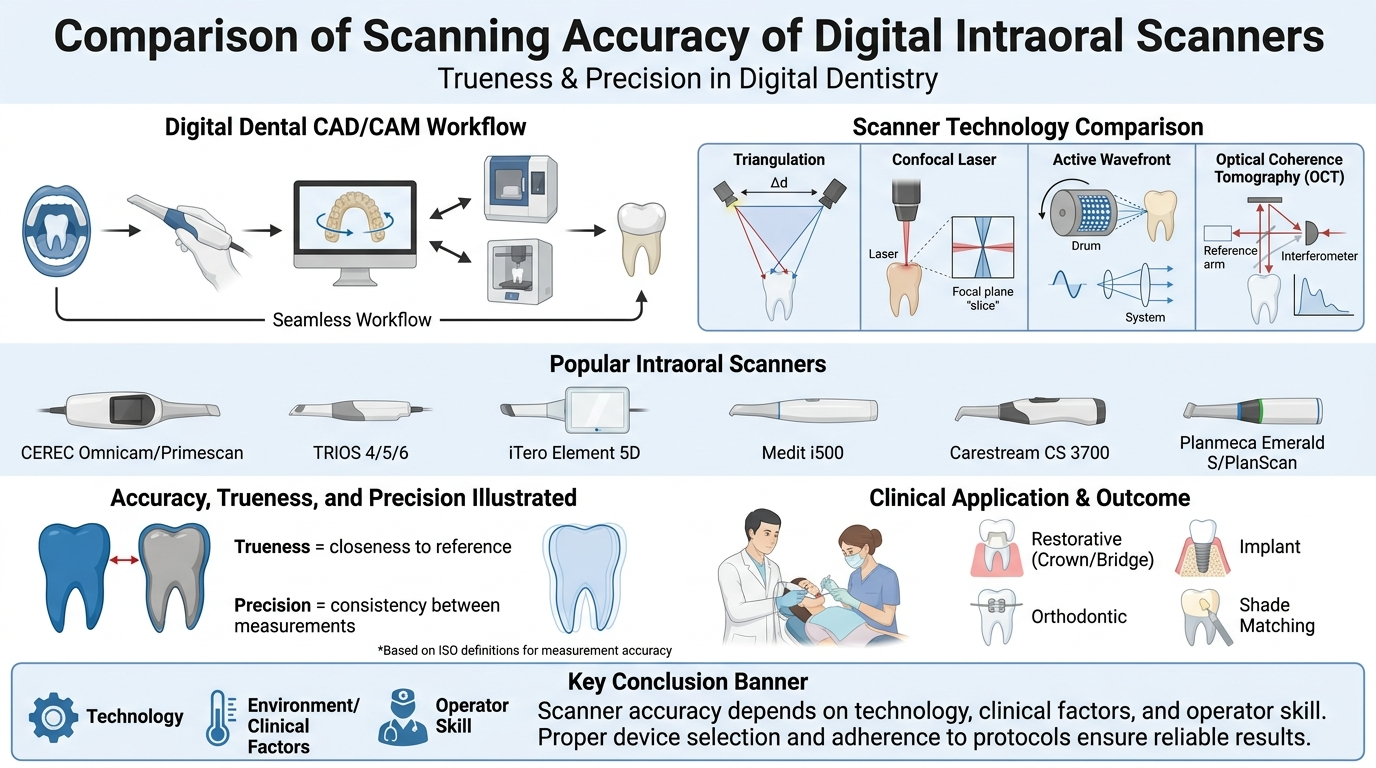
    Digital intraoral scanners (IOSs) have gained significant importance in modern dentistry by offering accurate, efficient, and patient-friendly alternatives to conventional impression techniques. This review aims to evaluate and compare the image quality and accuracy provided by various intraoral scanners, focusing on the current literature. Factors influencing image quality, such as scanning technology (confocal microscopy, triangulation, active wavefront sampling), operator experience, and scanning strategy, are also discussed. The evaluation includes commonly used IOS devices, including iTero, Trios, Medit i700, and CEREC Primescan, analyzing their performance in clinical and laboratory conditions. The literature suggests that while each scanner has strengths and limitations, all of them provide clinically acceptable results for prosthodontic and orthodontic applications. Furthermore, advancements in software and hardware are continuously enhancing image resolution, data acquisition speed, and ease of use. However, despite the progress, discrepancies in trueness and precision still exist depending on the scanning environment, scan area size, and material reflectivity. This review concludes that selecting an appropriate IOS should be based on clinical needs, operator preferences, and the specific task at hand. Continuous technological development and standardized evaluation methods are essential to further improve IOS reliability and integration into routine clinical practice.
    Accuracy, intraoral scanners, digital scanning, three-dimensional imaging, digital dentistry
    Elif Atasever, Server Mutluay Ünal
    27.08.2026
    e260823
    Abstract Views: 238 Download: 73 DOI 10.5577/jomdi.e260823
1 - 2 of 2 items

Journal Issue

Vol. 7 No. S1 (2026) Continuous Publication
View Current Issue

Published Volumes

2026
  • Vol. 7 No. S1 (2026): Current Developments in Prosthetic Dentistry
  • Vol. 7 (2026): Journal of Medical and Dental Investigations
2025
  • Vol. 6 No. S1 (2025): Current Developments in Pediatric Dentistry
  • Vol. 6 No. Advanced Online (2025): Journal of Medical and Dental Investigations
  • Vol. 6 (2025): Journal of Medical and Dental Investigations
2024
  • Vol. 5 (2024): Journal of Medical and Dental Investigations
2023
  • Vol. 4 (2023): Journal of Medical and Dental Investigations
2022
  • Vol. 3 (2022): Journal of Medical and Dental Investigations
Show more Show less
2021
  • Vol. 2 (2021): Journal of Medical and Dental Investigations

socialshare

Submit Your Paper
Become a Reviewer

sidebarmenu

Journal Menu

 Home

 Aims & scopes

 Editorial Board

 Author Guidelines

 Abstracting & Indexing

 Peer Review Process

 Ethics Statement

 Plagiarism Policy

 Digital Archiving Policy

 Corrections and Retractions

 Journal History

 Journal Statistics

 Society Information

 Language Editing

 Contact

idr


Citations
Updated daily Google Scholar
All Since 2021
Citations 41 41
h-index 3 3
i10-index 0 0
0 5 10 15 20
  • 2 2023
  • 7 2024
  • 20 2025
  • 12 2026
Citations per year
Year Citations
2023 2
2024 7
2025 20
2026 (to date) 12

2026 counts citations recorded so far this year.

ithenticate

Indexed in CiteLink


Signatory of DORA

Latest publications

  • Atom logo
  • RSS2 logo
  • RSS1 logo

Information

  • For Readers
  • For Authors
  • For Librarians

Browse

  • Categories
    • DENTISTRY
    • MEDICINE
    • Open Access
    • Original Article
    • Review
    • Case Report
    • Letter to Editor
Most Read Articles
  • Restorative options for primary teeth in pediatric dentistry
    3132 3132 views 2025
  • Use of platelet-rich fibrin (PRF) in the periodontology: A review
    2931 2931 views 2023
  • Does a sloped neck implant design facilitate All-on-4 surgeries? A three-dimensional finite element analysis
    2068 2068 views 2023
  • How to manage the cataract with nystagmus under topical anesthesia: A case report
    2025 2025 views 2023
  • Potential complications and preventive measures in pediatric dental treatments performed under general anesthesia and sedation
    1979 1979 views 2025
Most Cited Articles
  • Evaluation of time exposure of different irrigation agents on radicular dentin erosion
    7 7 citations 2022
  • Use of platelet-rich fibrin (PRF) in the periodontology: A review
    6 6 citations 2023
  • Comparison of second mesiobuccal canal prevalence of maxillary molar teeth by gender and age in a Turkish subpopulation: A cone-beam computed tomography study
    4 4 citations 2021
  • Evaluation of dentists’ approach to retreatment in Turkey: A survey study
    3 3 citations 2023
  • Does a sloped neck implant design facilitate All-on-4 surgeries? A three-dimensional finite element analysis
    3 3 citations 2023

visitors

Visitors 

Flag Counter

Web Analytics Made Easy - Statcounter

View My Stats

announcement

Announcement

logo
E-ISSN: 2822-6453

Download App

Contact

Publisher: Journal of Medical and Dental Investigations

Email: info@jomdi.org

Website: www.jomdi.org

Address: Publisher ZEUS PUBLISHING www.zeuspublishing.com

Social Media

CiteLinkEBSCOOpen AccessCrossrefGoogle ScholarCOPECreative Commons

Copyright © 2020-2026 | Journal of Medical and Dental Investigations . All rights reserved.
CC BY Open Access articles are distributed under the terms of the Creative Commons Attribution 4.0 International License,
which permits unrestricted use, distribution, and reproduction provided the original work is properly cited.

Privacy notice

This journal stores a session cookie that is required for the site to work, and keeps usage statistics that do not identify you.

More information