
Full-arch dental impressions: Conventional, digital, and photogrammetric techniques
DOI:
https://doi.org/10.5577/jomdi.e260826Keywords:
Full-arch impression, conventional impression, digital impression, intraoral scanner, photogrammetry, implant-supported prosthesis, impression accuracyAbstract
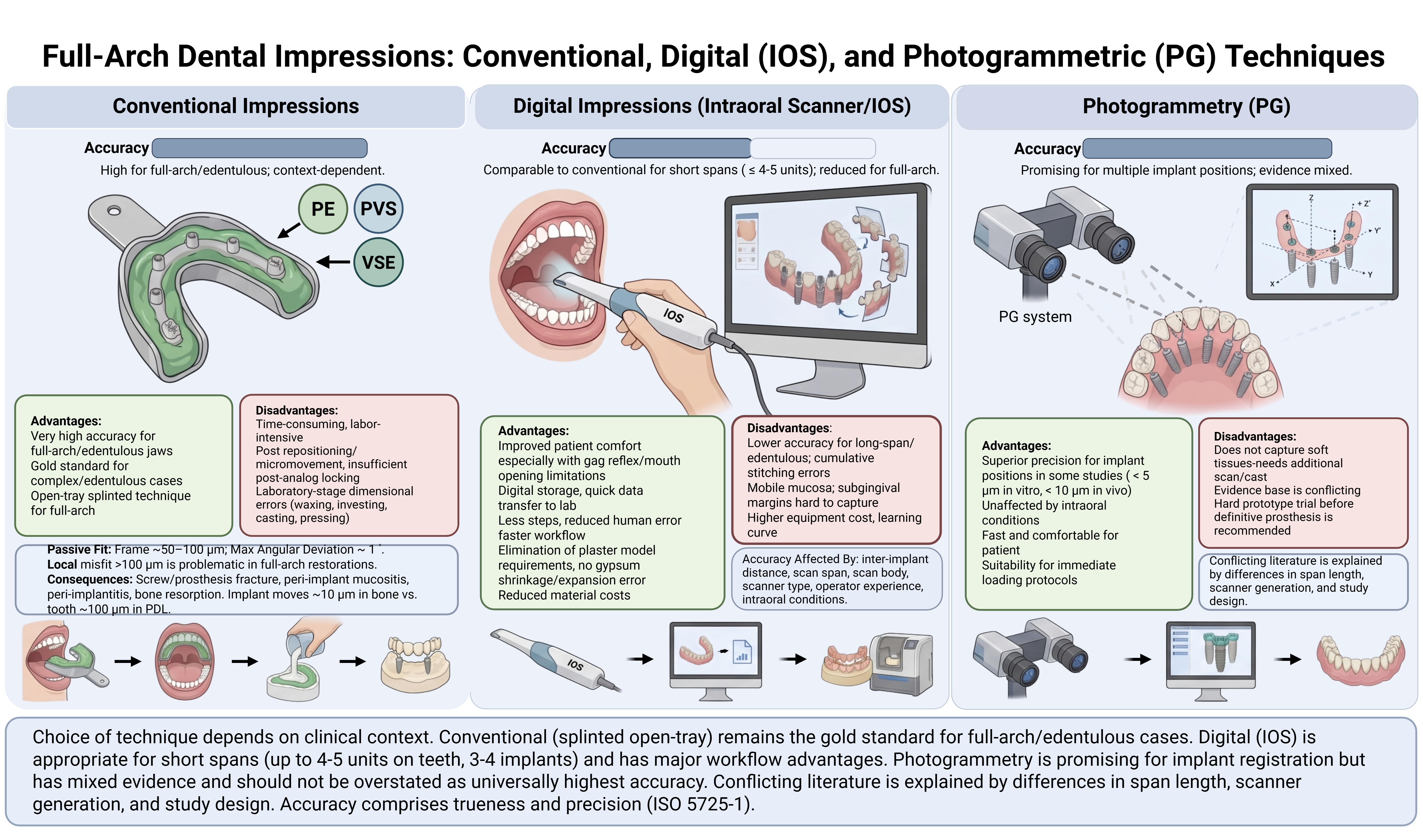
Advances in digital dentistry now permit the fabrication of full-arch prosthetic restorations through a fully digital workflow, extending from impression acquisition to the production of the definitive prosthesis. Intraoral scanning has become an acceptable alternative to conventional impression techniques, providing valuable information for diagnosis, restorative dentistry, orthodontic analysis, and implant-supported prosthodontics. Despite the many advantages offered by digital methods, conventional impression techniques using polyether, polyvinyl siloxane, and vinyl siloxanether materials remain widely used by clinicians because of their excellent dimensional stability and well-documented precision. This review compares and critically discusses conventional and digital impression techniques for acquiring full-arch dental registrations, with particular attention to their accuracy, advantages, limitations, and clinical indications. The accuracy of digital impressions is strongly influenced by inter-implant distance, scan span length, scan body geometry and material, scanner type, operator experience, and intraoral conditions such as mobile mucosa, saliva, and limited anatomical landmarks. For single-unit and short-span restorations of up to four or five units, intraoral scanning achieves accuracy comparable to that of conventional techniques. In long-span and full-arch restorations, however, accuracy tends to decline owing to cumulative image-stitching errors and the scarcity of reference points, a problem that is especially pronounced in completely edentulous arches. Photogrammetry has emerged as a promising alternative for the reliable registration of multiple implant positions, although it inadequately captures peri-implant soft tissues. Overall, technique selection depends primarily on the number of teeth or implants and the distance between them; conventional methods remain preferable for completely edentulous patients, whereas digital workflows are suitable for restorations spanning up to three or four implants. Despite persisting limitations, digital techniques are strong candidates to eventually outperform conventional approaches in dentistry.
Downloads
Downloads
Published
Issue
Section
Categories
License
Copyright (c) 2026 The Author(s)

This work is licensed under a Creative Commons Attribution 4.0 International License.

This is an Open Access article distributed under the terms of the Creative Commons Attribution 4.0 International License (CC BY 4.0), which permits unrestricted use, distribution, and reproduction in any medium, provided the original work is properly cited.






















 Open Access articles are distributed under the terms of the