
How should I scan for measurement accuracy in full-arch scans?
DOI:
https://doi.org/10.5577/jomdi.e260829Keywords:
Full-arch scanning, intraoral scanner, trueness and precision, segmental scanning, digital impressionAbstract
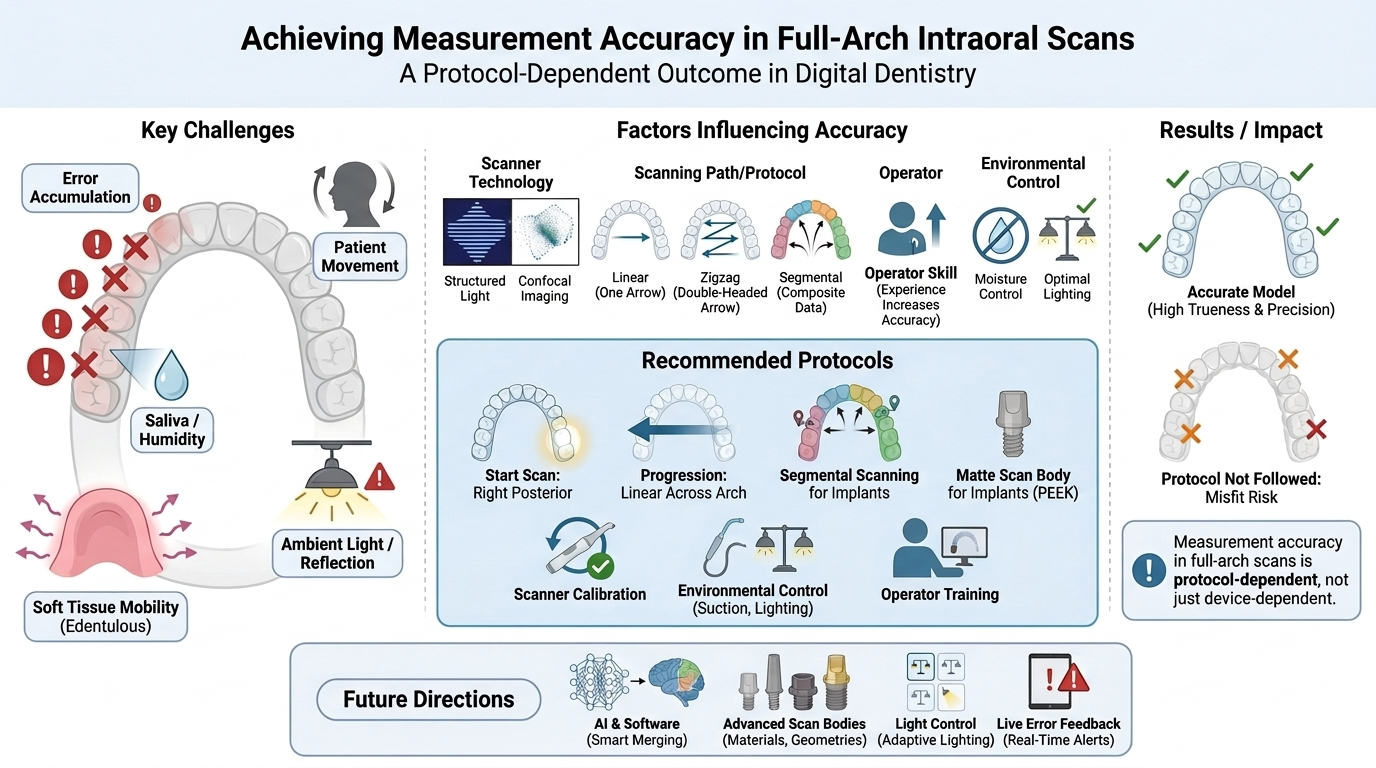
The integration of intraoral scanners (IOSs) into routine clinical practice has transformed full-arch digital impression-making, offering improved patient comfort and the potential for high measurement accuracy. However, ensuring reliable trueness and precision across large arch spans remains challenging because of the cumulative errors that arise when extended areas are scanned, which can compromise the fit of prosthetic restorations, generate stress within implant-supported frameworks, and introduce clinically relevant errors in orthodontic planning. This review synthesizes the current evidence on the technical, biological, and operator-related factors that influence full-arch scanning accuracy and outlines clinically applicable strategies to minimize error. The principal challenges discussed include local error accumulation, patient movement, saliva and moisture, soft-tissue mobility in edentulous arches, and operator fatigue, all of which can lead to volumetric deformation of the digital model. Key determinants of accuracy are examined, including scanner technology, scanning path and starting-point selection, operator experience, oral humidity, ambient light, and implant scan-body characteristics. Recommended scanning patterns—linear, zigzag, and segmental approaches—are compared and discussed, together with region-specific strategies for the anterior and posterior segments. The evidence indicates that a disciplined protocol markedly improves trueness and precision: linear progression from the posterior toward the anterior region, segmental scanning in implant-supported cases, regular scanner calibration, a constant scanning speed and distance, effective moisture and ambient-light control, the use of matte scan bodies such as PEEK, and continuous operator training. Future research should prioritize intelligent auto-alignment algorithms, standardized implant scan-body geometries and materials, multicenter evaluation of environmental conditions, and artificial-intelligence-based real-time error detection to further enhance the reliability of digital impressions in clinical practice.
Downloads
Downloads
Published
Issue
Section
Categories
License
Copyright (c) 2026 The Author(s)

This work is licensed under a Creative Commons Attribution 4.0 International License.

This is an Open Access article distributed under the terms of the Creative Commons Attribution 4.0 International License (CC BY 4.0), which permits unrestricted use, distribution, and reproduction in any medium, provided the original work is properly cited.






















 Open Access articles are distributed under the terms of the