
Current CAD/CAM materials
DOI:
https://doi.org/10.5577/jomdi.e260824Keywords:
CAD/CAM, block materials, metal alloys, ceramics, polymer blocks, digital dentistryAbstract
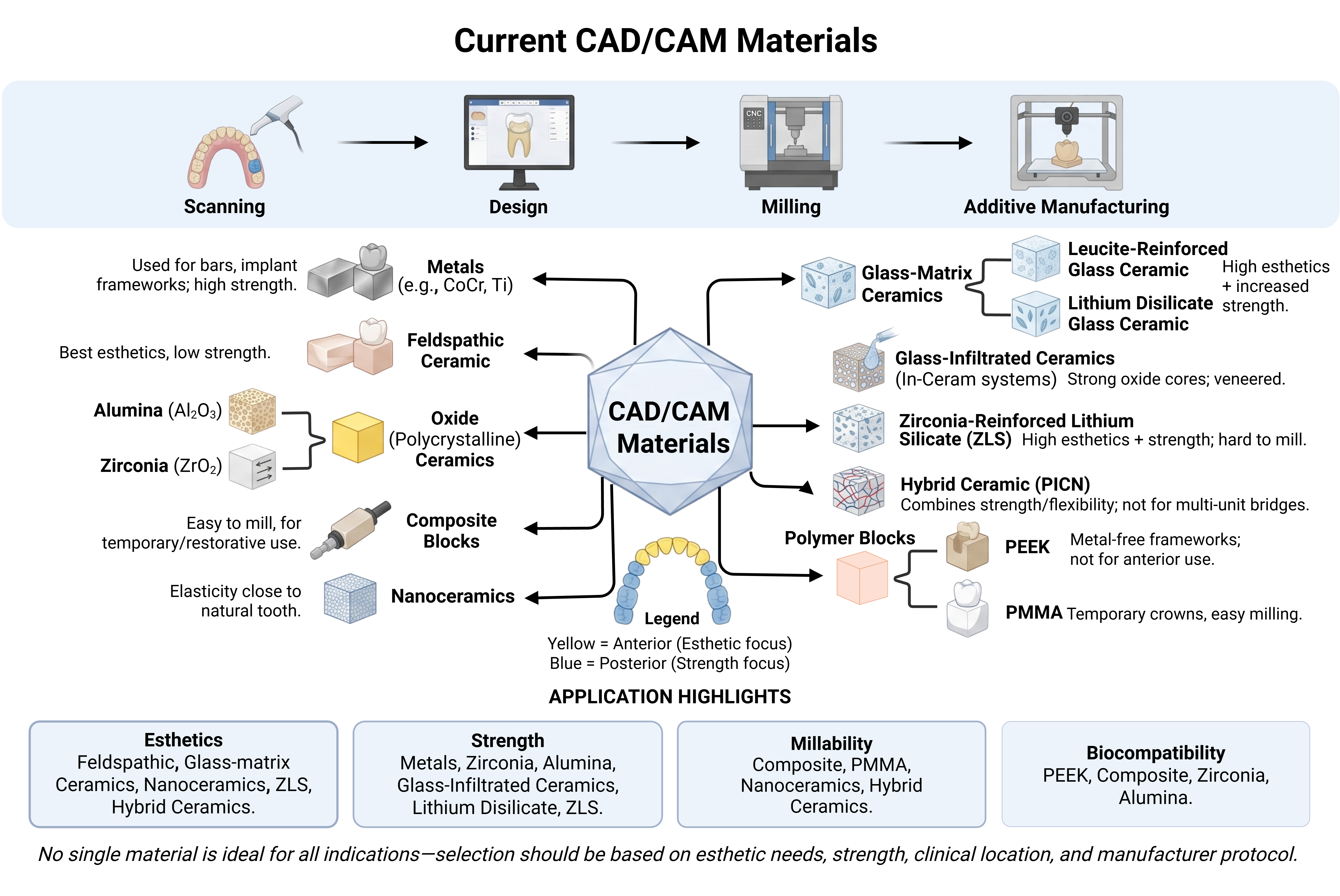
Computer-aided design and computer-aided manufacturing (CAD/CAM) technologies have fundamentally reshaped restorative and prosthetic dentistry, streamlining both chairside and laboratory workflows while improving the speed, accuracy, and predictability of treatment. As the range of millable materials continues to expand, evidence-based, indication-specific selection has become increasingly challenging for clinicians and dental technicians alike. This review classifies and critically evaluates contemporary CAD/CAM materials according to their chemical composition—metal, ceramic, composite, polymer, and hybrid—and compares their performance to support rational treatment planning. Drawing on current literature, it surveys a broad spectrum of materials, including metal alloy blocks; feldspathic, leucite-reinforced, and lithium disilicate glass ceramics; glass-infiltrated and polycrystalline oxide ceramics (alumina and yttria-stabilized zirconia); resin nanoceramics; polymer-infiltrated hybrid ceramics; zirconia-reinforced lithium silicate; composite blocks; and polymer blocks such as PEEK and PMMA. For each group, mechanical strength, optical and esthetic properties, biocompatibility, clinical indications, advantages, and limitations are presented within a comparative framework, and the influence of production strategy—chairside versus centralized fabrication and hard versus soft milling—on restoration fit and longevity is discussed. Reported flexural strength ranged from approximately 150 MPa for feldspathic ceramics to well above 1000 MPa for high-strength zirconia, revealing consistent trade-offs between mechanical performance and translucency, most evident as the cubic phase of zirconia increases. Lithium disilicate and zirconia emerged as leading options balancing esthetics and durability, whereas PEEK and composite materials offered advantages in biocompatibility, elasticity, and provisional applications. Overall, no single material is universally optimal; selection should be guided by the specific clinical indication, esthetic demand, and occlusal load, with ongoing advances in digital dentistry expected to further broaden material choice and clinical performance.
Downloads
Downloads
Published
Issue
Section
Categories
License
Copyright (c) 2026 The Author(s)

This work is licensed under a Creative Commons Attribution 4.0 International License.

This is an Open Access article distributed under the terms of the Creative Commons Attribution 4.0 International License (CC BY 4.0), which permits unrestricted use, distribution, and reproduction in any medium, provided the original work is properly cited.





















 Open Access articles are distributed under the terms of the