
Comparison of scanning accuracy of different digital intraoral scanners
DOI:
https://doi.org/10.5577/jomdi.e260823Keywords:
Accuracy, intraoral scanners, digital scanning, three-dimensional imaging, digital dentistryAbstract
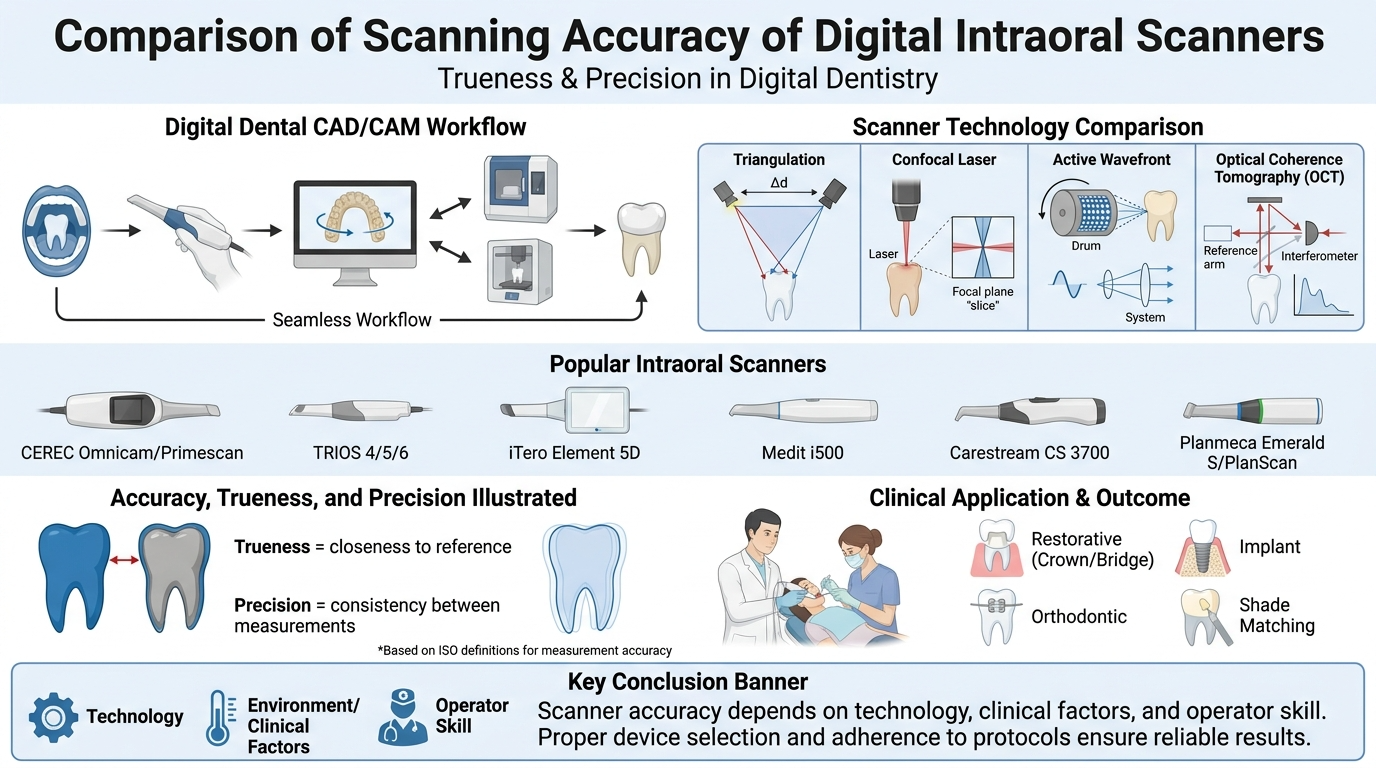
Digital intraoral scanners (IOSs) have gained significant importance in modern dentistry by offering accurate, efficient, and patient-friendly alternatives to conventional impression techniques. This review aims to evaluate and compare the image quality and accuracy provided by various intraoral scanners, focusing on the current literature. Factors influencing image quality, such as scanning technology (confocal microscopy, triangulation, active wavefront sampling), operator experience, and scanning strategy, are also discussed. The evaluation includes commonly used IOS devices, including iTero, Trios, Medit i700, and CEREC Primescan, analyzing their performance in clinical and laboratory conditions. The literature suggests that while each scanner has strengths and limitations, all of them provide clinically acceptable results for prosthodontic and orthodontic applications. Furthermore, advancements in software and hardware are continuously enhancing image resolution, data acquisition speed, and ease of use. However, despite the progress, discrepancies in trueness and precision still exist depending on the scanning environment, scan area size, and material reflectivity. This review concludes that selecting an appropriate IOS should be based on clinical needs, operator preferences, and the specific task at hand. Continuous technological development and standardized evaluation methods are essential to further improve IOS reliability and integration into routine clinical practice.
Downloads
Downloads
Published
Issue
Section
Categories
License
Copyright (c) 2026 The Author(s)

This work is licensed under a Creative Commons Attribution 4.0 International License.

This is an Open Access article distributed under the terms of the Creative Commons Attribution 4.0 International License (CC BY 4.0), which permits unrestricted use, distribution, and reproduction in any medium, provided the original work is properly cited.






















 Open Access articles are distributed under the terms of the