
Can digital impression methods eliminate the current problems of conventional impression techniques?
DOI:
https://doi.org/10.5577/jomdi.e260815Keywords:
Digital impression, intraoral scanner, conventional impression, trueness and precision, prosthodonticsAbstract
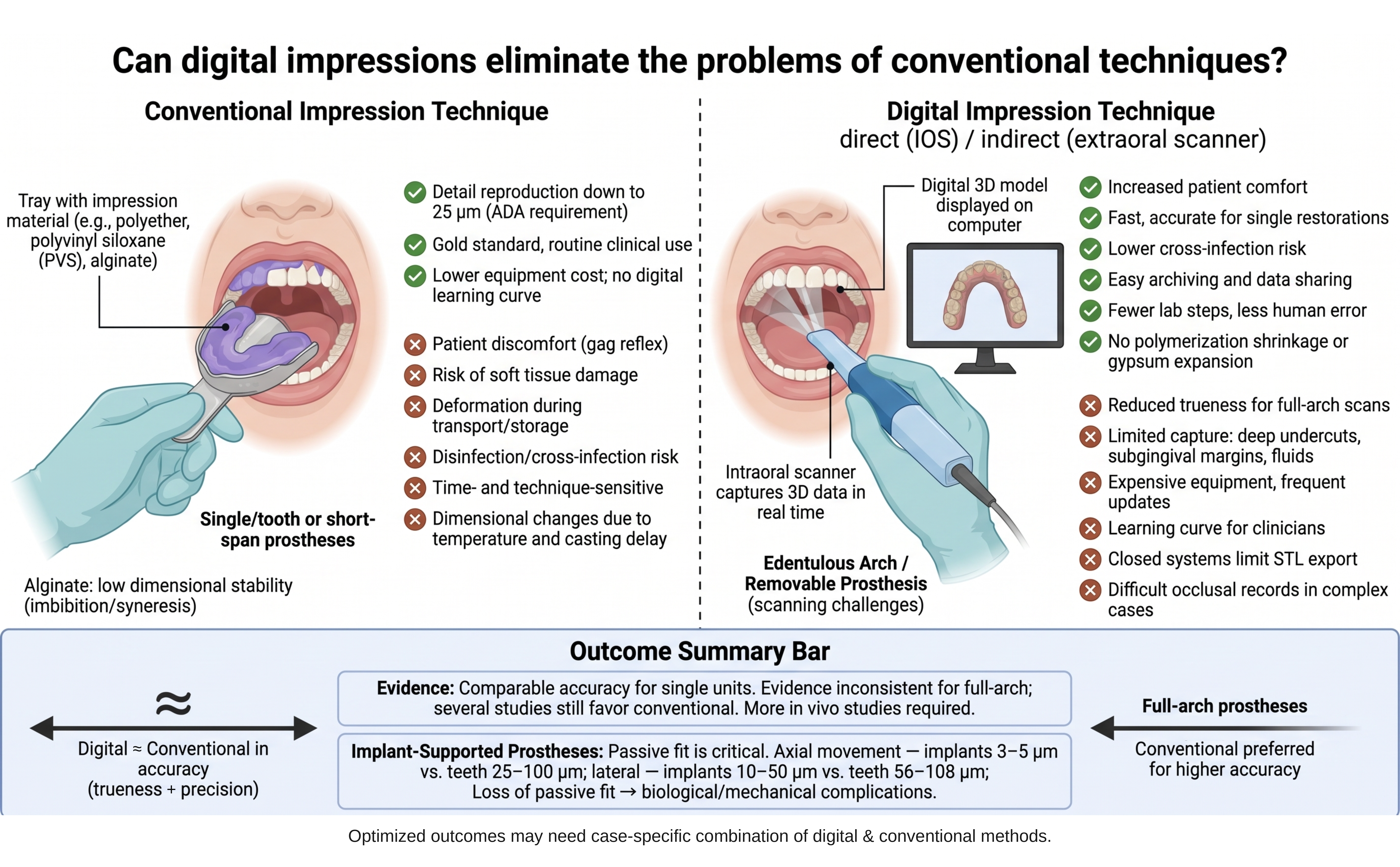
Conventional impression materials remain a cornerstone of routine dental practice, yet they carry well-documented drawbacks, including a pronounced gag reflex, limited patient comfort, potential soft-tissue trauma, dimensional changes with temperature and elapsed time, the need for disinfection, cross-infection risk, and susceptibility to distortion during transport, storage, and laboratory handling. Digital impression systems have been introduced to overcome these limitations, and their use in dentistry—particularly in prosthodontics—continues to expand. This review compares conventional and digital impression techniques and examines whether digital workflows can resolve the shortcomings inherent to conventional methods. Conventional elastomers such as polyether and addition-type silicones offer excellent dimensional stability and detail reproduction and are currently regarded as the gold standard. Digital impressions, obtained with intraoral or extraoral scanners, provide clear advantages in patient comfort, procedure time, reduced cross-infection risk, elimination of polymerization shrinkage and gypsum expansion, and convenient digital archiving and transfer. However, their accuracy is influenced by scanning area, scanner sensitivity, operator experience, moisture, patient movement, and inter-implant distance. The reviewed literature indicates that intraoral scanners achieve clinically acceptable accuracy for single units and single-quadrant restorations, whereas evidence for full-arch and multiple implant-supported prostheses remains inconsistent, with several studies still favoring conventional impressions. Accuracy—comprising trueness and precision—is especially critical for passive fit in implant-supported restorations. Most comparative data derive from in vitro models that do not reproduce intraoral conditions such as saliva, blood, and patient movement, underscoring the need for further in vivo research. In conclusion, although the benefits of digital impressions are evident, their long-term clinical efficacy and safety require additional investigation, and technique selection should weigh accuracy, time efficiency, learning curve, and cost. A case-specific combination of digital and conventional approaches may offer added benefit.
Downloads
Downloads
Published
Issue
Section
Categories
License
Copyright (c) 2026 The Author(s)

This work is licensed under a Creative Commons Attribution 4.0 International License.

This is an Open Access article distributed under the terms of the Creative Commons Attribution 4.0 International License (CC BY 4.0), which permits unrestricted use, distribution, and reproduction in any medium, provided the original work is properly cited.






















 Open Access articles are distributed under the terms of the