
Vitamin B12 deficiency and borderline levels in children aged 0–18 years: A retrospective cross-sectional study
DOI:
https://doi.org/10.5577/jomdi.e250102Keywords:
Adolescent, age factors, child, cobalamin, retrospective studies, vitamin B12 deficiencyAbstract
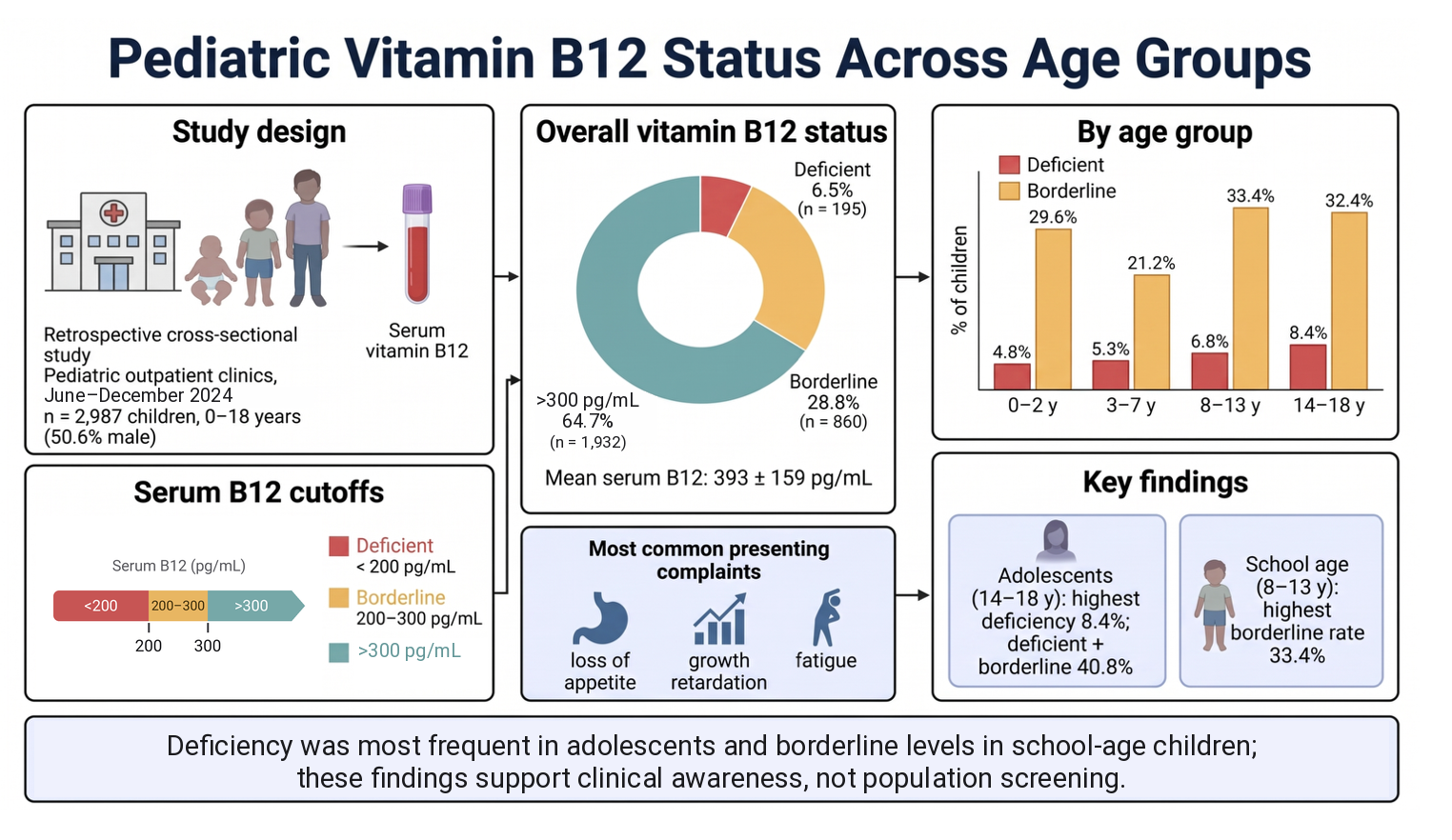
Aim: This study aimed to determine the frequency of vitamin B12 deficiency in children admitted to pediatric outpatient clinics and how it varies according to age groups.
Methodology: This retrospective cross-sectional study included children aged 0–18 years who presented to pediatric outpatient clinics between June 1 and December 17, 2024, and underwent serum vitamin B12 testing. Concentrations <200 pg/mL were classified as deficient and 200–300 pg/mL as borderline. Pearson chi-square tests were used for categorical comparisons. Supplementary mean comparisons used Welch ANOVA and Holm-adjusted pairwise Welch tests calculated from rounded summary statistics.
Results: A total of 2987 patients admitted to pediatric outpatient clinics were evaluated. B12 deficiency was found in 6.5% and borderline levels in 28.8% of the children. Deficiency was observed in 6.7% of boys and 6.3% of girls; the overall association between sex and B12 category was not statistically significant (p=0.056). The most common presenting complaints were loss of appetite (28.7%), growth retardation (21.3%), and fatigue (15.9%). The mean serum vitamin B12 level was 393±159 pg/mL. When vitamin B12 deficiency was analyzed according to age groups, the highest rate of serum vitamin B12 deficiency was observed between 14–18 years of age (8.4%) and the lowest rate was observed between 0–2 years of age (4.8%). The distribution of B12 categories differed significantly across age groups (χ²=56.003, p<0.001).
Conclusion: In this study, the rates of serum vitamin B12 deficiency in children presenting to the outpatient clinic were shown. Deficiency was found to be more frequent, especially during the adolescent period, and borderline levels were detected in 28.8% of the children. The selected sample limits generalizability; these findings alone do not establish a population screening strategy.
Downloads
References
Bailey RL, West KP Jr, Black RE. The epidemiology of global micronutrient deficiencies. Ann Nutr Metab. 2015;66(suppl 2):22-33. https://doi.org/10.1159/000371618
Orhan Ö, Solmaz M. Investigation of vitamin D, vitamin B12 and ferritin levels in children receiving home health care services in southeastern Türkiye. Ann Med Res. 2023;30(9):808-813. https://doi.org/10.5455/annalsmedres.2023.08.188
Mandal P, Chandra J. Vitamin B12 deficiency in children. Indian J Hematol Blood Transfus. 2025;41(4):753-764. https://doi.org/10.1007/s12288-025-02025-8
Jensen CF. Vitamin B12 levels in children and adolescents on plant-based diets: a systematic review and meta-analysis. Nutr Rev. 2023;81(8):951-966. https://doi.org/10.1093/nutrit/nuac096
Zengin Ersoy G, Şirin Koç B, Çakı Kılıç S. Folate and vitamin B12 status in pediatric hematopoietic stem cell transplantation patients. Nutrients. 2025;17(3):377. https://doi.org/10.3390/nu17030377
World Health Organization. Guideline: Fortification of Wheat Flour With Vitamins and Minerals as a Public Health Strategy. World Health Organization; 2022. Accessed August 20, 2025. https://iris.who.int/bitstream/handle/10665/354783/9789240043398-eng.pdf
Coşkun T. B12 vitamini. Katkı Pediatri Derg. 2003;25(2):419-433.
Stabler SP. Vitamin B12 deficiency. N Engl J Med. 2013;368(2):149-160. https://doi.org/10.1056/NEJMcp1113996
Green R. Vitamin B12 deficiency from the perspective of a practicing hematologist. Blood. 2017;129(19):2603-2611. https://doi.org/10.1182/blood-2016-10-569186
Allen LH. How common is vitamin B-12 deficiency? Am J Clin Nutr. 2009;89(2):693S-696S. https://doi.org/10.3945/ajcn.2008.26947A
Türk Hematoloji Derneği. B12 vitamini eksikliği tanı ve tedavi kılavuzu. Accessed August 16, 2025. https://www.thd.org.tr/thddata/books/94/bolum-i-b12-vitamini-eksikligi-tani-ve-tedavi-kilavuzu.pdf
McLean E, de Benoist B, Allen LH. Review of the magnitude of folate and vitamin B12 deficiencies worldwide. Food Nutr Bull. 2008;29(2 suppl):S38-S51. https://doi.org/10.1177/15648265080292S107
de Benoist B. Conclusions of a WHO Technical Consultation on folate and vitamin B12 deficiencies. Food Nutr Bull. 2008;29(2 suppl):S238-S244. https://doi.org/10.1177/15648265080292S129
Çağ Y, Özdemir A, Alay M. Mülteci çocuklarda B12 vitamini eksikliği. Bozok Tıp Derg. 2020;10(1):196-201.
Hay G, Trygg K, Whitelaw A, Johnston C, Refsum H. Folate and cobalamin status in relation to diet in healthy 2-year-old children. Am J Clin Nutr. 2011;93(4):727-735. https://doi.org/10.3945/ajcn.110.004374
Pektaş E, Aral YZ, Yenisey Ç. The prevalence of anemia and nutritional anemia in primary school children in the city of Aydın. Meandros Med Dent J. 2015;16(3):97-107. https://doi.org/10.4274/meandros.42073
Chandyo RK, Ulak M, Kvestad I, et al. Cobalamin and folate status among breastfed infants in Bhaktapur, Nepal. Nutrients. 2018;10(5):589. https://doi.org/10.3390/nu10050589
Azad C, Jat KR, Kaur J, et al. Vitamin B12 status and neurodevelopmental delay in Indian infants: a hospital-based cross-sectional study. Paediatr Int Child Health. 2020;40(2):78-84. https://doi.org/10.1080/20469047.2019.1638130
Akin F, Yavuz H, Bodur S, Kiyici A. Vitamin B12 levels of subjects aged 0-24 year(s) in Konya, Turkey. J Health Popul Nutr. 2014;32(4):615-622.
Sayar EH, Orhaner BB, Sayar E, Nesrinturan F, Küçük M. The frequency of vitamin B12, iron, and folic acid deficiency in the neonatal period and infancy, and the relationship with maternal levels. Turk Pediatr Ars. 2020;55(2):139-148. https://doi.org/10.14744/TurkPediatriArs.2020.91592
Erdöl Ş. Önemli bir halk sağlığı problemi: vitamin B12 eksikliği. J Curr Pediatr. 2017;15(2):26-33. https://doi.org/10.4274/jcp.48765
Finkelstein JL, Kurpad AV, Thomas T, Srinivasan K, Duggan C. Vitamin B12 status in pregnant women and their infants in South India. Eur J Clin Nutr. 2017;71(9):1046-1053. https://doi.org/10.1038/ejcn.2017.39
Kadiyala A, Palani A, Rajendraprasath S, Venkatramanan P. Prevalence of vitamin B12 deficiency among exclusively breastfed term infants in South India. J Trop Pediatr. 2021;67(1):fmaa072. https://doi.org/10.1093/tropej/fmaa072
Yetim A, Tıkız C, Baş F. Ergenlik döneminde D ve B12 vitamin eksikliklerinin sıklığı. J Child. 2017;17(1):24-29. https://doi.org/10.5222/j.child.2017.024
Sürücü Kara İ, Aydın Peker N, Dolğun İ, Mertoğlu C. Vitamin B12 level in children. J Curr Pediatr. 2023;21(2):127-134. https://doi.org/10.4274/jcp.2023.75688
Culha Hosceylan I, Kallemoglu T, Basibuyuk M, Karabayir N. Iron and vitamin B12 levels in school-age children. J Pediatr Hematol Oncol. 2025;47(7):e321-e326. https://doi.org/10.1097/MPH.0000000000003100
Downloads
Published
Issue
Section
Categories
License
Copyright (c) 2025 The Author(s)

This work is licensed under a Creative Commons Attribution 4.0 International License.

This is an Open Access article distributed under the terms of the Creative Commons Attribution 4.0 International License (CC BY 4.0), which permits unrestricted use, distribution, and reproduction in any medium, provided the original work is properly cited.






















 Open Access articles are distributed under the terms of the