
CAD/CAM technology in dentistry
DOI:
https://doi.org/10.5577/jomdi.e260817Keywords:
CAD/CAM, dental ceramics, monolithic zirconia, intraoral scanner, marginal adaptation, digital workflowAbstract
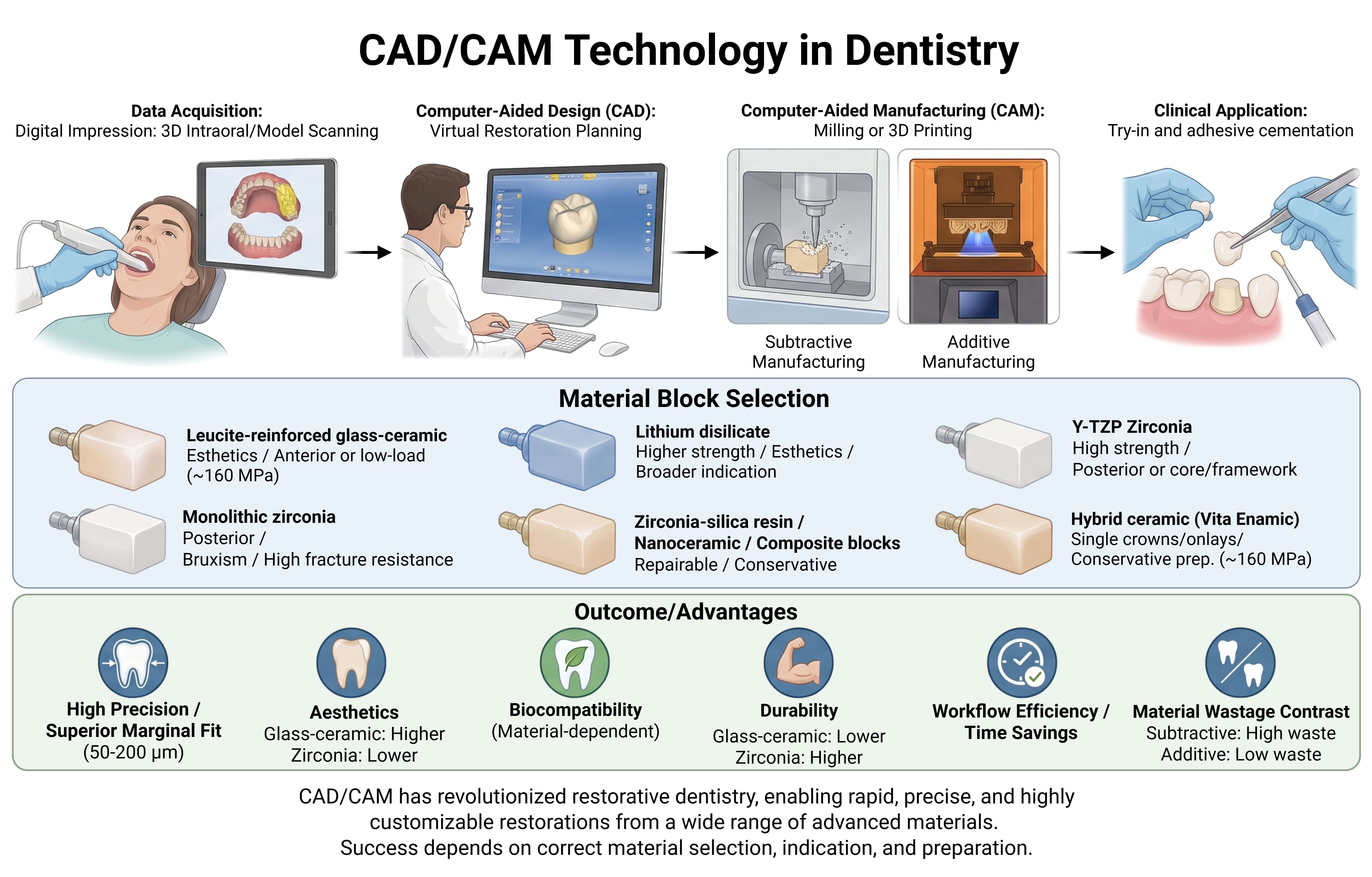
The remarkable advancement of dental materials, treatment techniques, and prosthesis manufacturing processes has elevated computer-aided design and manufacturing (CAD/CAM) systems to a new level of clinical capability. Since its introduction to dentistry in the 1980s—beginning with the chairside CEREC system and the Procera framework concept—CAD/CAM has reshaped contemporary practice by enabling aesthetic, durable, and reliably reproducible restorations while transforming the way laboratories design and fabricate both framework (substructure) and monolithic restorations. Because the production stages are tightly controlled and the material blocks are industrially processed, modern CAD/CAM materials also offer improved structural properties—reduced microporosity, greater homogeneity, and lower firing shrinkage—relative to conventionally processed ones, while reducing laboratory steps, working time, and the overall error rate. This narrative review examines the principal CAD/CAM restorative materials, the digital data-processing workflow, and restoration production methods, together with their influence on marginal fit. The main material classes are described—leucite- and lithium-disilicate-reinforced glass ceramics, yttria-stabilized tetragonal zirconia polycrystals (Y-TZP) and monolithic zirconia, resin-matrix and nanoceramic blocks, composite blocks, and hybrid ceramics such as Vita Enamic—with their compositions, mechanical properties, indications, and limitations, including flexural strengths ranging from approximately 160 MPa for glass ceramics to substantially higher values for zirconia. The data-processing stage, comprising direct intraoral and indirect model scanning followed by computer-aided design of a virtual model, is reviewed, along with the two production routes: subtractive milling from prefabricated blocks and additive fabrication by selective laser sintering and 3D printing, which minimizes material waste. Marginal adaptation is discussed as a key determinant of restorative success, with reported clinically tolerable misfit values of 50 to 200 µm and CAD/CAM milling shown to provide superior marginal conformance to conventional techniques. Overall, CAD/CAM workflows offer measurable gains in material quality, accuracy, and efficiency over conventional methods, although optimal outcomes depend on correct material selection, appropriate indication, and proper tooth preparation.
Downloads
Downloads
Published
Issue
Section
Categories
License
Copyright (c) 2026 The Author(s)

This work is licensed under a Creative Commons Attribution 4.0 International License.

This is an Open Access article distributed under the terms of the Creative Commons Attribution 4.0 International License (CC BY 4.0), which permits unrestricted use, distribution, and reproduction in any medium, provided the original work is properly cited.





















 Open Access articles are distributed under the terms of the